Computing, games & IT
Computing, games & IT
Computing, games & IT
At Luleå University of Technology in Skellefteå, you can study the bachelor’s program Game Development and Programming. Three years, 180 ECTS credits, entirely in English. The program is built on an engineering foundation and combines courses in game engine architecture, AI programming, physics simulation, and graphics with practical game production projects. You learn to program for real, not just assemble assets in a game engine. That difference is exactly what opens doors far beyond the games industry.
What you actually learn
The program covers the entire chain from the ground up. You learn to build the underlying systems and rules that govern a game: how physical phenomena such as gravity, collisions, and movement are simulated, how AI-controlled characters behave intelligently and credibly, and how game engines are structured and how they can be rebuilt. Graphics programming is also included, with a focus on visual effects and performance. The technology and software used in the program reflect what the industry actually uses today.
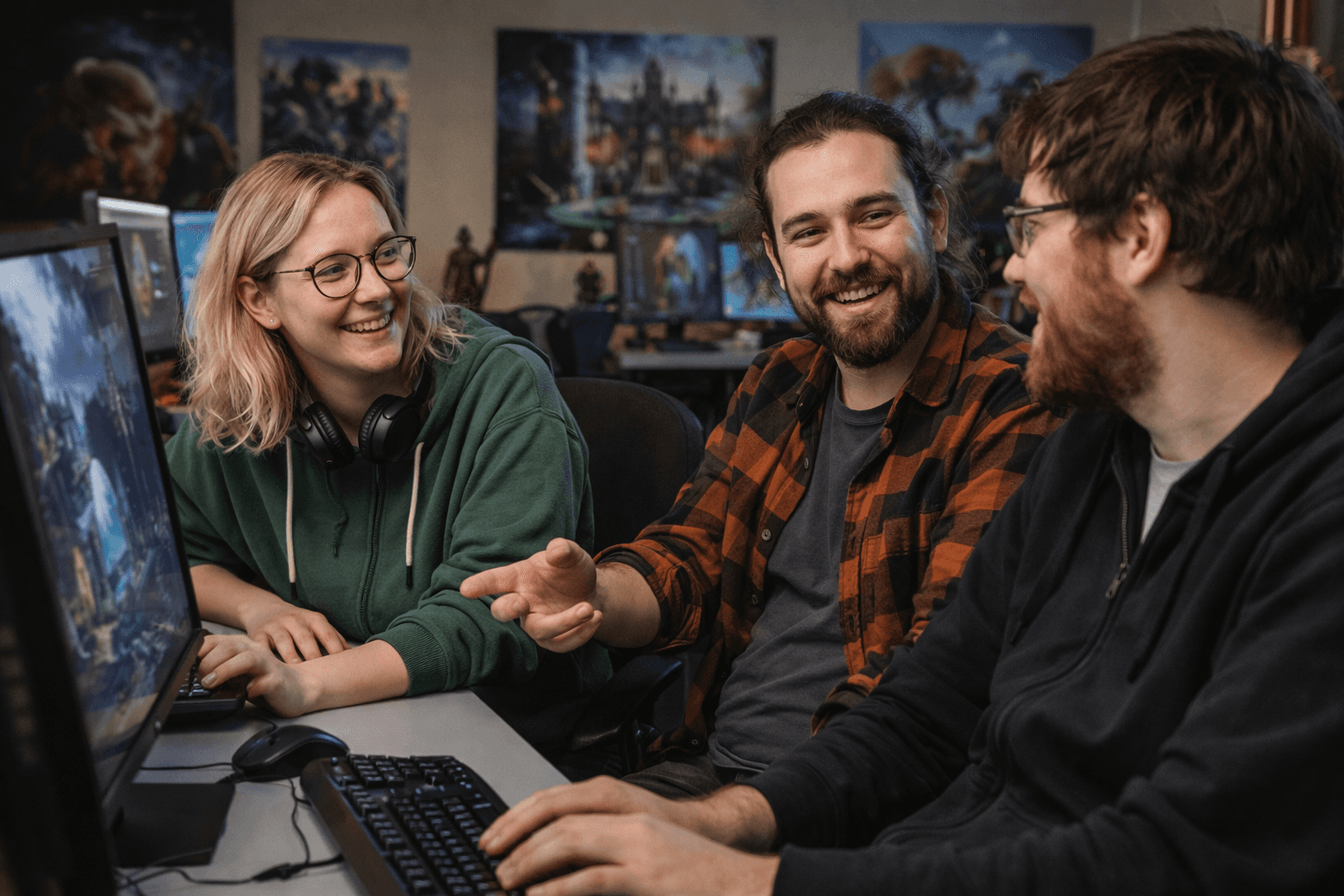
Alongside the technical courses, you work on creative game projects, both individually and in groups. You work in authentic production environments and have the opportunity to collaborate with students from the Computer Graphics for Games and Film program—the same way professional teams work in the industry. At the end of the program, you complete a degree project, and many choose to do it at a company, in Sweden or abroad.
"Former students work at companies like Embark, Avalanche, and Ubisoft."
After graduation, the entire game industry is within reach, from large international companies to smaller indie studios. Former students work at companies such as Embark, Avalanche, and Ubisoft.
But that is not the whole picture. The deep programming expertise the program provides also makes you attractive in the broader job market—within consulting firms, systems development, and tech in general. A game programmer writes code for extremely performance-demanding real-time systems. That ability is in demand widely, far beyond game studios. A university degree also carries significant weight in the recruitment process, in Sweden and internationally.
For those considering a career change
Programming is one of the few professions where a solid three-year education can take you from zero to in demand. And an education with game programming as its foundation is no narrower than other programming programs. In many respects, it is tougher.
Those who graduate in Skellefteå can apply for jobs as game programmers, software developers, systems programmers, or technical consultants. The market is broad.
The program is taught in English and is open for applications for autumn 2026, starting on August 31.
Read more about the Bachelor's programme in Computer Game Development and Programming
Apply no later than April 15!